MARKET INTELLIGENCE / GLOBAL MACRO
The Global Market Sell-Off: AI Doubts, Rate Fears and a Record IPO
Markets entered the week under pressure after a sharp global sell-off led by technology shares. The retreat reached beyond stocks, hitting commodities and crypto too. A rebound is possible, but investors still need evidence that the main sources of uncertainty are easing.
Last week’s sell-off spread across markets
The week ended 20 November with a heavy fall on Wall Street. On Friday, the S&P 500 dropped 3.7%, the Nasdaq Composite fell 5.3%, and the Dow Jones Industrial Average lost 1.9%. The S&P 500 entered correction territory — more than 10% below its recent high — while the Nasdaq turned negative for the year. Asian shares fell further on Monday, with South Korea’s Kospi down 5.8%, the Hang Seng down 1.8% and Shanghai’s main index down 1.4%.
The weakness was not confined to equities. Gold fell 8.9% over the week, oil prices eased and Bitcoin dropped below US$57,000 on Friday. Government bonds, by contrast, drew buyers as investors sought safety. That combination is consistent with a broader effort to reduce risk and raise cash, not merely a routine pullback in a small group of technology shares.
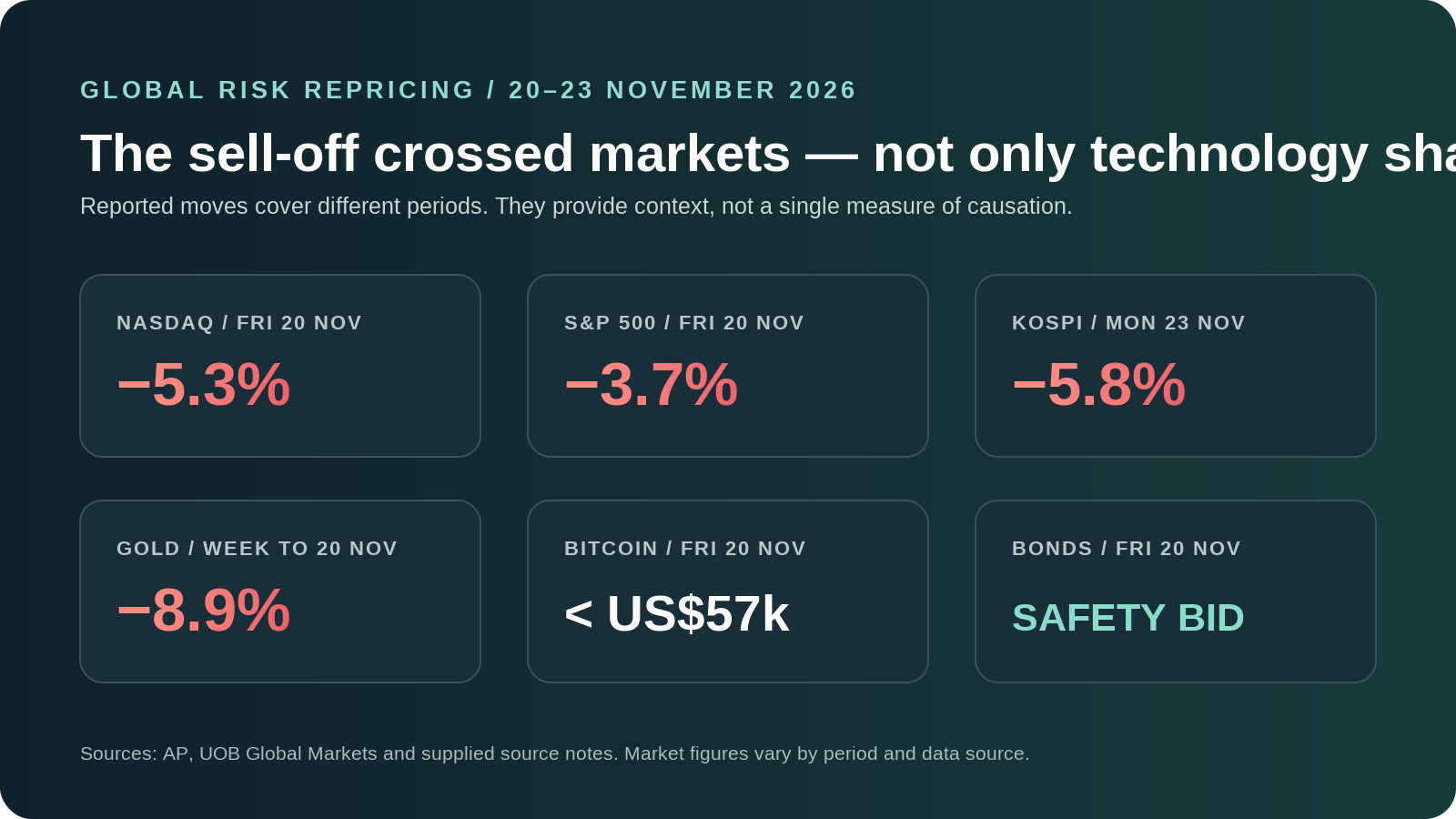
Figures cover different periods and measures. They illustrate the breadth of the risk-off move, not like-for-like performance.
Why the AI trade is under pressure
Investors are reassessing whether expected profits from artificial intelligence will justify the scale of spending on chips, data centres, energy and related infrastructure. The concern is not that AI lacks commercial value. It is that the market may have priced in years of growth before companies have demonstrated that the investments can earn adequate returns.
That doubt persisted even after strong earnings from AI-linked companies. Technology stocks had become among the most heavily owned and highly valued parts of the market, so reduced exposure there placed pressure on major indexes and businesses connected to the AI build-out. Leadership uncertainty at Nvidia added to the uncomfortable backdrop described in contemporaneous market reporting.
What Anthropic’s IPO signals about investor cash
Anthropic’s IPO became a major market event in the middle of this repricing. The company priced shares at US$83. Its stock rose on the first day of trading, then fell 8.5% on Friday. The retreat did not erase the initial gain, but it showed that even a landmark listing could not by itself restore confidence across the AI sector.
The offering may have influenced how some investors allocated capital. A fund seeking a large position in a new listing might use cash or reduce other holdings, and cash committed to an offering is tied up until settlement. Those effects can matter at the margin when markets are unsettled. They do not establish the IPO as the cause of the wider global sell-off.
The final prospectus helps frame the cash-flow story. It lists about US$78.8 billion before expenses for Anthropic and about US$1.95 billion before expenses for existing shareholders who sold shares. The concurrent US$26.0 billion private placement adds further scale. This is a very large capital raise for the company — not evidence that an equivalent sum was simply withdrawn from markets.
Rate concerns are adding to the strain
AI worries have collided with uncertainty around US monetary policy. Persistent inflation and hawkish signals have led investors to consider whether rates may stay higher for longer. Higher rates tend to weigh on growth-stock valuations because a larger share of their expected value lies in future cash flows.
The reaction was not one-way: bond prices rose as investors sought safety during the equity fall. That does not remove rate risk. It shows the market balancing concern about inflation and policy against concern that a severe sell-off could slow growth. Incoming US inflation and economic reports can move that balance again.
What to watch this week
- Inflation and growth data: whether they reshape expectations for rates.
- Technology guidance: whether AI demand is keeping pace with the investment required to supply it.
- Market breadth: whether any rebound extends beyond a narrow group of stocks.
- Cross-asset behaviour: whether gold, crypto, credit and government bonds remain aligned with a risk-off signal.
Three paths from here
These are scenarios to monitor, not assigned probabilities or price targets.
A broader recovery develops
Inflation data are reassuring, rate expectations settle and technology shares find a more durable base. A recovery is more credible if gains broaden beyond a small group of names.
Markets remain range-bound and selective
Investors see value after the sell-off but maintain caution on rates, AI spending and valuation. Liquidity and balance-sheet quality remain important.
Risk reduction continues
A disappointing signal from inflation, policy, company guidance or AI investment could prompt another round of selling and a further move toward cash or safer assets.
No scenario is a recommendation, forecast or guarantee.
The takeaway
The market has not yet shown that its underlying concerns have passed. Early rebounds can reflect bargain-hunting or short-term positioning. A more durable recovery would need clearer evidence: stable rate expectations, a more convincing AI investment case and participation across a wider set of assets.
Source notes
- Associated Press — US market close, Asian market reporting and Anthropic trading context, 20–23 November 2026.
- UOB Global Markets — supplied market context on cross-asset conditions.
- Anthropic final prospectus, SEC filing — offering price, proceeds and concurrent private-placement details, filed 19 November 2026.