SpaceX After the IPO: Access, Valuation, and What Investors Need to Watch

SpaceX is no longer a private-market curiosity. After its record-setting June 2026 IPO, the company moved from restricted secondary access into the public market, immediately broadening the investor base and forcing a much faster repricing of its story. The result is a stock that is now easier to buy, easier to monitor, and still difficult to value with conventional frameworks.
TradeX view: the major change is access, not certainty. SpaceX now offers mainstream investors a way into one of the most discussed private companies in the world, but the post-IPO price still embeds an aggressive view on Starlink durability, Starship execution, and AI monetization.
SpaceX priced 555.6 million shares at $135 before the greenshoe was fully exercised.
The stock surged to an intraday high on June 16, showing how violently the market was repricing the narrative.
Even after a sharp pullback, the stock remained well above its IPO price and still carried a premium public valuation.
Real operating scale exists, but the market is still paying mostly for future optionality rather than current earnings quality.
Why the IPO matters
Before the listing, most investors could only access SpaceX through tender programs, funds, or private secondaries. In practice, that meant accreditation requirements, large minimums, slow settlement, and inconsistent liquidity. The IPO changed that structure overnight. Public access did not make the company simple, but it did make price discovery much cleaner and participation much broader.
That point matters because part of SpaceX’s mystique came from scarcity. In private markets, pricing is often opaque and fragmented. Public trading replaced that with real-time bids, visible volume, and immediate sentiment shifts. For the first time, SpaceX became a stock instead of just a story.
The early price action says more than the headline
The first two weeks of trading were a reminder that access does not reduce volatility. The stock opened strong, rallied aggressively, then gave back a large portion of those gains within days. That kind of move is typical when a company combines a huge narrative premium, a relatively constrained effective float, and heavy retail interest.
In practical terms, the public chart is showing a market still trying to decide what SpaceX actually is. If investors treat it as a next-generation infrastructure platform, the valuation can stay elevated. If they frame it as an aerospace company with exceptional execution but still heavy capital needs, the multiple becomes much harder to defend.
SpaceX Journey
This infographic summarizes the company’s path from foundation through early launches, Dragon and ISS integration, reusability breakthroughs, Starship development, and its eventual scale into a public-market story.
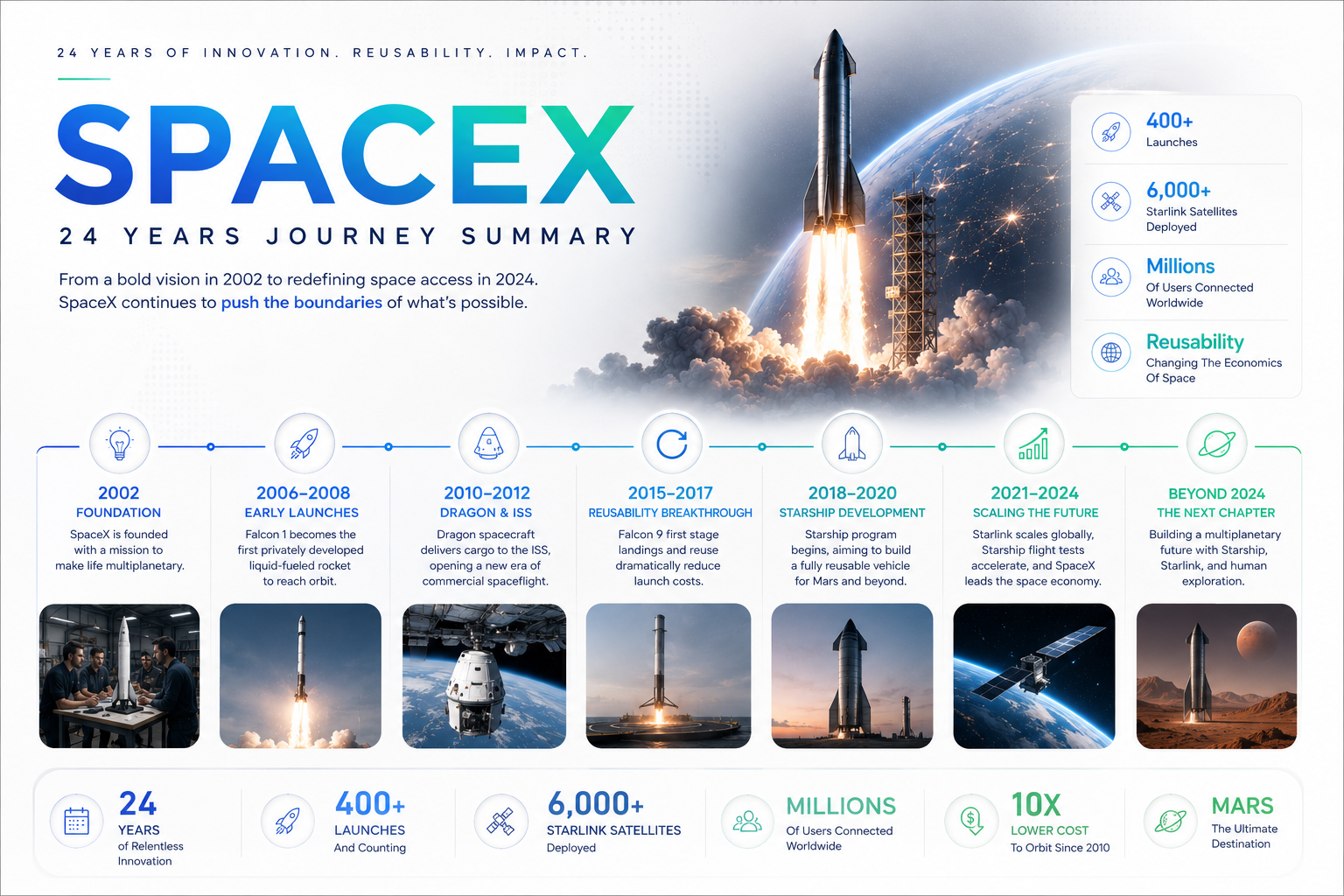
A visual timeline of SpaceX’s evolution from a 2002 founding story to a scaled launch, satellite, and infrastructure platform.
The strongest part of the business is not speculative. Connectivity appears to be the core profit engine, and subscriber scale continues to expand rapidly.
Losses, capital intensity, and the scale of forward expectations mean the market is still underwriting years of execution with very little room for disappointment.
What the underlying business actually looks like
One reason the stock is so hard to value is that SpaceX is really several businesses inside one company. The Connectivity segment, led by Starlink, appears to be the strongest economic engine. It produced meaningful operating income and adjusted EBITDA in 2025, giving investors a real business line they can anchor to.
The picture becomes more complex once the rest of the company is included. The Space segment remains strategically important but capital-heavy, especially with continued Starship investment. The AI segment is where the future upside narrative becomes most ambitious, but it is also where losses and capital deployment are most intense.
This is why the company cannot be read through a single lens. It is partly a broadband platform, partly a launch and orbital infrastructure company, and partly a long-duration AI buildout. Investors are not just pricing today’s earnings power. They are pricing the possibility that these pieces reinforce one another over time.
Why valuation is the real debate
At the IPO price, SpaceX was already valued far above what conventional aerospace comparisons would justify. The issue is not whether the company is impressive. It clearly is. The issue is whether current valuation leaves enough upside for new investors once the market has already capitalized a large share of the long-term dream.
The balance sheet and capital expenditure profile are central here. SpaceX spent heavily in 2025 and continued deploying capital aggressively into 2026. That can be shareholder-friendly if it creates dominant infrastructure and future cash flow. It can also become a problem if monetization lags behind spending, especially in AI.
The simplest way to frame the stock is this: Starlink supports the case, Starship expands the case, and AI stretches the case. The broader the narrative becomes, the more valuation depends on execution across all three.
What investors should watch next
- Starlink economics: subscriber growth matters, but so do pricing quality and ARPU stability.
- Capital intensity: investors need evidence that heavy capex is building durable returns rather than only expanding ambition.
- AI monetization: this remains one of the biggest upside drivers and one of the least-proven parts of the story.
- Float and lockup effects: the stock can remain unstable if supply increases into a market still trading the narrative.
- Narrative discipline: the more the market treats SpaceX as a universal platform story, the more sensitive the stock becomes to any execution miss.
TradeX stance
Our read is that SpaceX deserves serious attention, but not casual valuation assumptions. The business quality is stronger than many post-IPO stories because there is already genuine scale and a visible profit center. At the same time, the stock is still trading as a high-expectation asset rather than a fully de-risked compounder.
For long-horizon investors who can tolerate deep swings, the name remains strategically important. For new capital, the cleaner stance is patience. The access problem has been solved by the IPO, but the valuation question has not.
Key takeaway: SpaceX is easier to buy than ever before, but it is not easier to value. The better approach is to separate admiration for the business from discipline around the stock.